From Ray Arden's 1947 glow plug to the Cox Space Bug of 1952 — how the .020, .045 and .049 "midgets" revolutionised American model aviation in just a few short years, told ad by ad and engine by engine.
Note: in the late 1940s and early 1950s the three major model-airplane magazines were Air Trails (AT), Flying Models (FM), and Model Airplane News (MAN). Very similar or identical ads ran in all three; for this article I reference almost exclusively MAN.
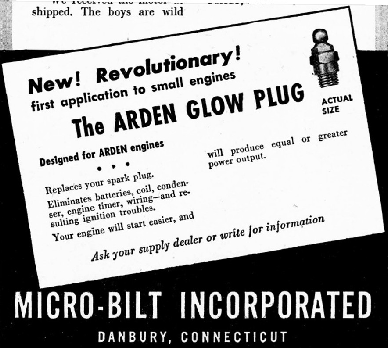
Even though he had used a glow plug as early as 1908, Ray Arden didn't market one until 1947. He passed some around at the Nationals that year and finally advertised them in the November 1947 MAN. Now a model engine could be run without a set of points, condenser, coil, and heavy batteries — all of which was weight the model had to carry into the air, and which generally meant models had to be rather large. Diesels could do the same, but although there were several excellent diesels in the USA they never caught on as they did in the rest of the world. Now that models could be smaller, engines could be smaller too.
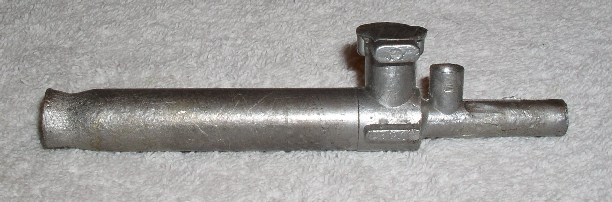
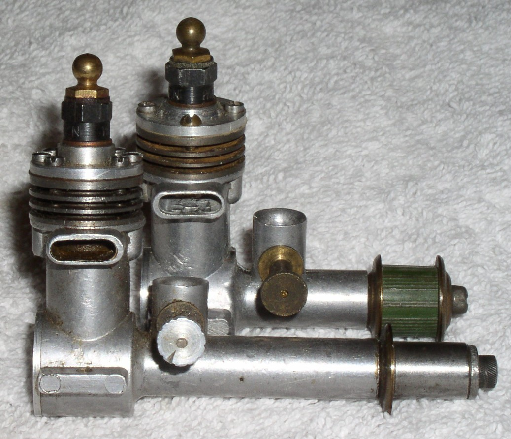
In 1948 a Boeing machinist, Elmer Larsen, designed a tiny .049 glow engine. He made a small number for modelers in the Seattle area but never produced them commercially. There were two versions — a "Royal 05" and a long-nosed "Royal 05 Scale." The Royals used Arden glow plugs, which give a good idea of the size of the engines.
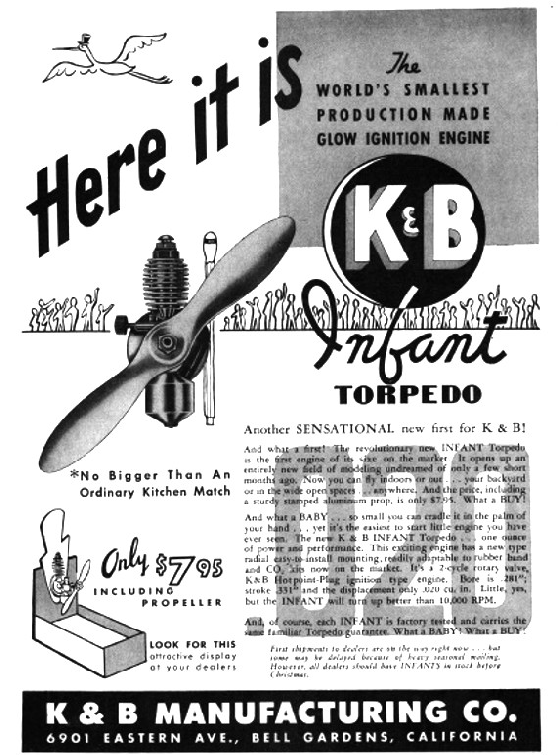
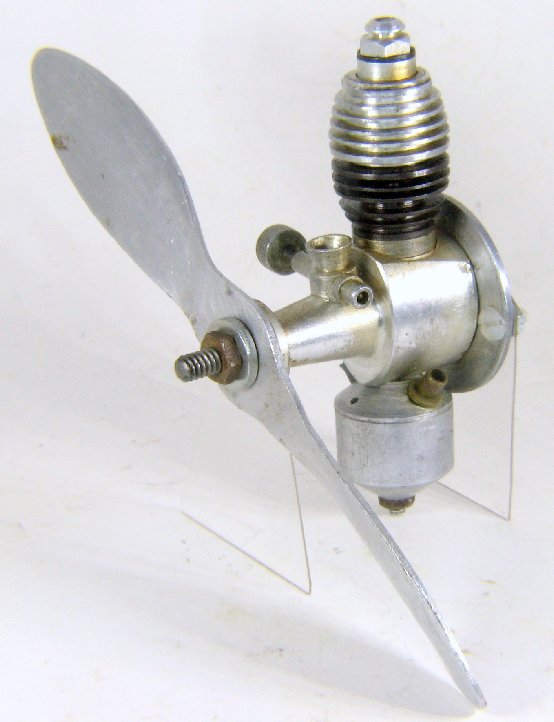
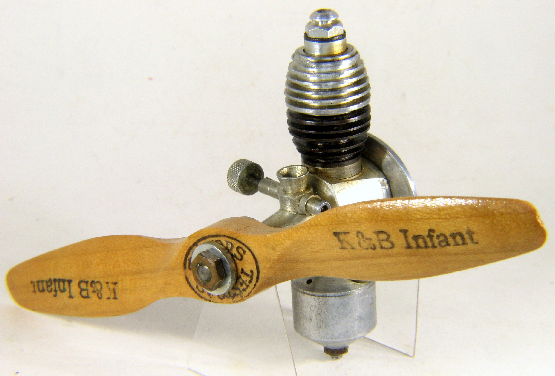
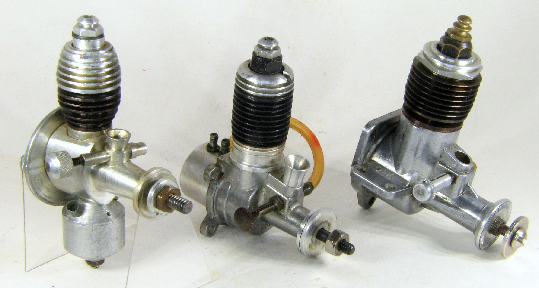
Working on his own time since 1947, Lud Kading — the "K" of K&B — had designed a glow engine the size of a kitchen match, trying to see how small he could make one that was reliable. The Infant .020 (.281" × .332" bore and stroke) was the fruit of his labor, machined from bar stock with no castings. Advertised in 1949, it was on dealers' shelves for Christmas 1948. Lud's glow plug sat on top of the cylinder, captured by a head ring that clamped it tight — the plug was, in effect, the top of the combustion chamber, a feature that surely figured in its success.
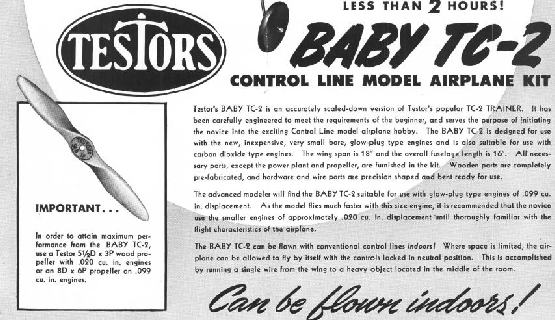
The Infant was sold with a stamped aluminum prop. The story goes that someone at K&B realized there were no props suitable for the .020s, so a 4¼" propeller was designed, stamped from aluminum, and included with the engine. The Infant was a huge success — almost immediately, plans for .020-sized models began appearing in magazines. Testors scaled down its .09 TC-2 ukie trainer into the "Baby TC-2" for Infant-type engines, and brought out a 5¼"D × 3P prop just for .020s.
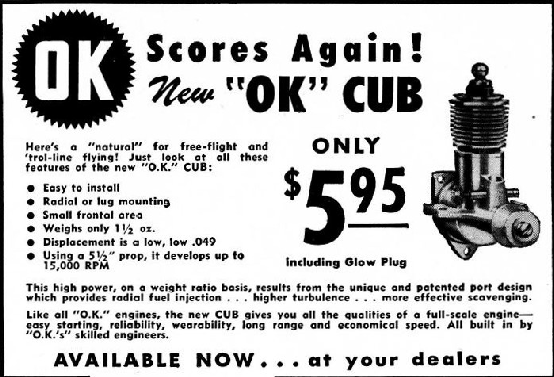
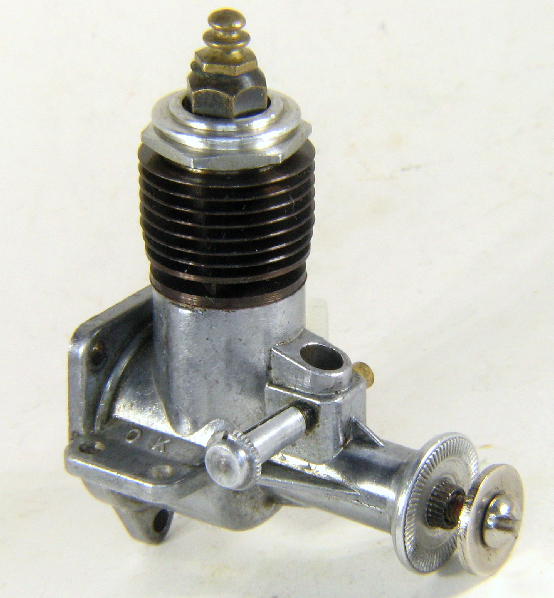
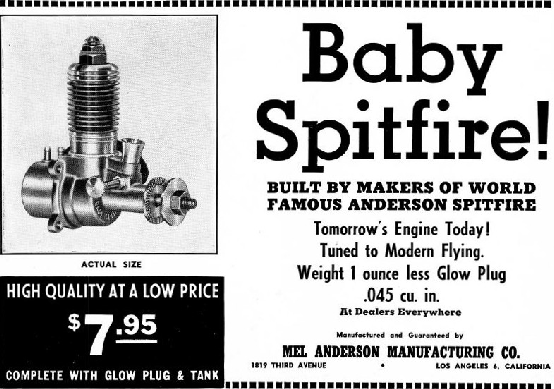
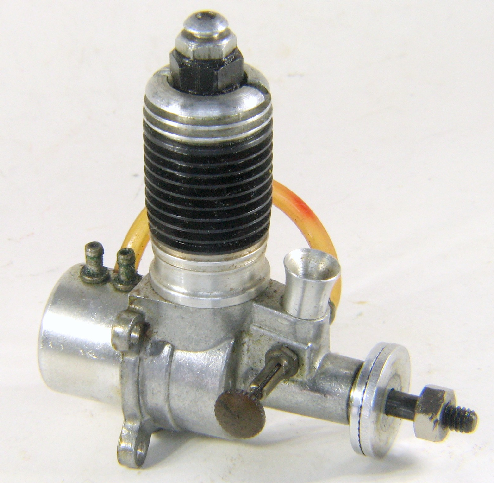
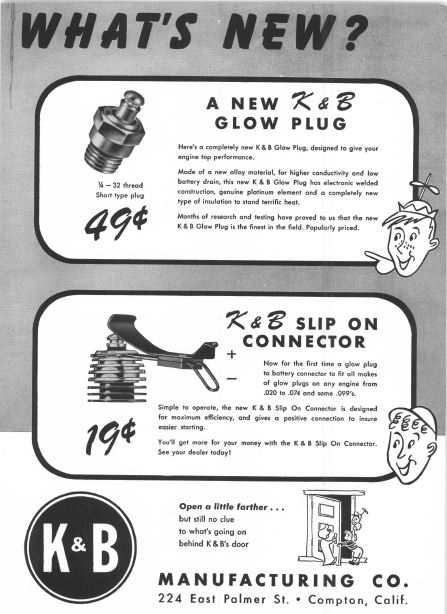
Other manufacturers had not been sleeping. In June 1949 Herkimer announced the OK CUB — the first commercially produced .049 (Elmer's groundbreaking Royals had been custom-made). OK used the Arden plug, not yet selling their own; this was also the first time an OK engine was called a "CUB." The next month Mel Anderson showed up with his Baby Spitfire .045 (the West Coast News column in the June MAN had already mentioned it, so the CUB and Baby Spit were really out at the same time). The first Baby Spitfires used a ¼" × 32 K&B glow plug, with a rear-mounted tank and radial mounting lugs.
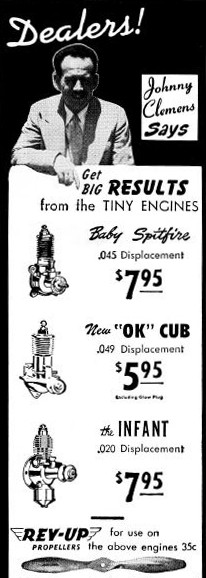
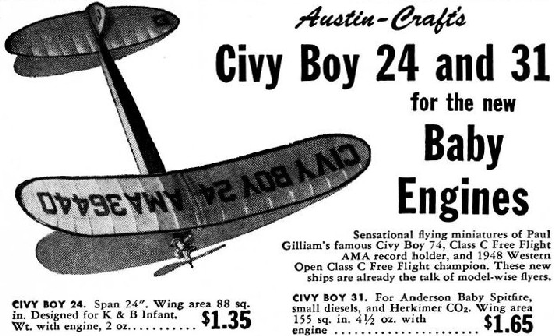
So in the first seven months of 1949, modeling was revolutionized — and fast. Props, kits, and fuel were all needed for the midgets. Several makers already had 6" props that worked with the CUB; Rev-Up came out with 5×2 and 5×3 props for the Infant and Baby Spit. Johnny Clemens, a future AMA president, ran an early ad with all three midgets and props for them. Small planes — especially small control-line planes — don't need as big a field as their larger brothers, and a plethora of pint-sized "ukies" began showing up in construction articles. A boy needed a fat wallet to build and fly the "big jobs," but not so with these new engines; and they weren't as intimidating to operate as a big barking .29. Free flight was another matter: full-sized ships scaled down very nicely, and Austin-Craft scaled down Paul Gilliam's legendary Civy Boy in two sizes.
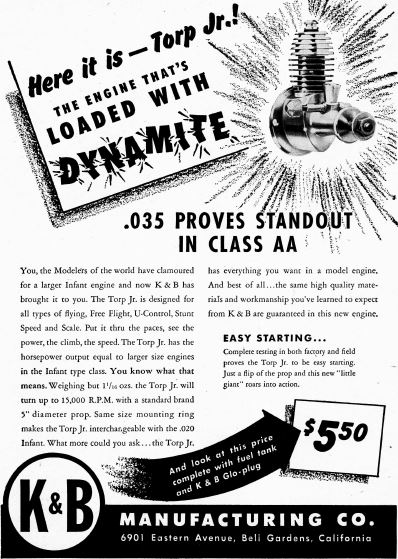
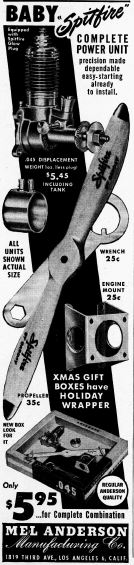
With competition in the AA (or A/2) midget class heating up, K&B scooped the field again with their excellent Torp Jr. .035 — it fit where an .020 had been used but gave a little more power. The Infant and Baby Spitfire had started at $7.95 with the Cub at $5.95; in November 1949 Anderson dropped the Baby Spitfire to $5.45 and K&B dropped the Infant to $4.95. Competition was benefitting modelers. In time for Christmas, Anderson offered a "bundle": the Baby Spitfire with its tank and the new "Spitfire" glow plug for $5.45, or $5.95 with a wrench, a Spitfire propeller, and an aluminum engine mount that cured the .045's mounting dilemma — all in a nice holiday gift box.
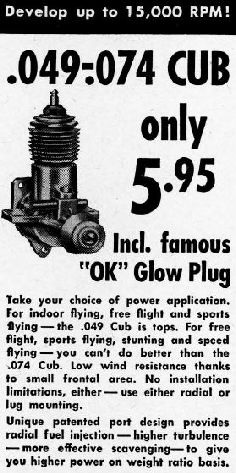
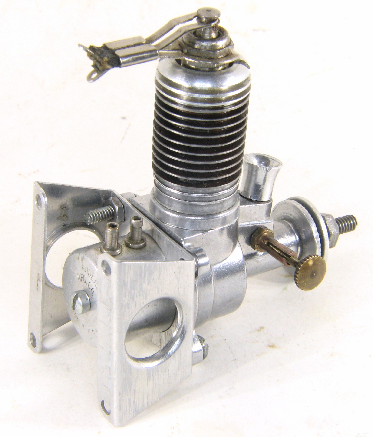
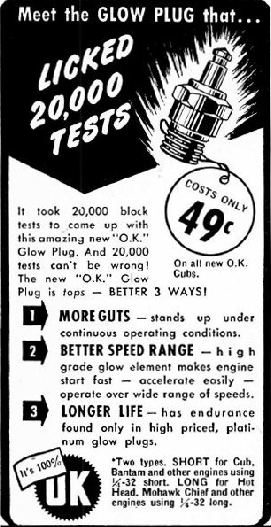
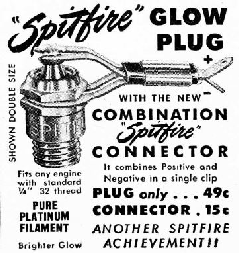
Herkimer sold engines worldwide, and outside the USA engines tended to follow metric sizes (.5, 1 and 1.5 cc, corresponding to .030, .060 and .09 in³). The CUB .049 had a .390" × .415" bore and stroke; by keeping the .049's stroke and lower-case dimensions and increasing the bore to .478", Herkimer had an .074 — between the .049 and .09, and close to 1 cc. Hedging their bets, Herkimer also designed an entirely new .099, close to 1.5 cc and sized to compete with the other American .099s (Arden, McCoy, etc.). Charles Brebeck of Herkimer — a gifted designer and astute businessman — designed his own plug and arranged with Shereshaw and Swanson to manufacture the OK glow plug, so Herkimer could join O&R and K&B as builders using their own brand of plug. By the start of 1950 all three midget makers had their own glow plug.
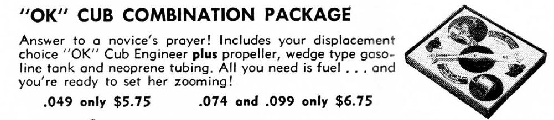
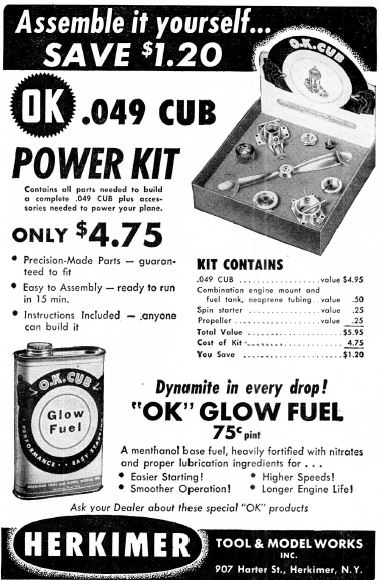
Things were quiet for a while as modelers bought and flew the small engines. Then OK brought out their combination package and, in the same issue, their "Power Kit" — all the fully machined parts to build a Cub .049, including OK's die-cast tank, an aluminum "Spin Starter," and a plastic propeller (probably the first plastic 1/2-A prop on the market, made for OK by Kaysun). Beginning on page 32 of the June 1950 MAN, Edward G. Ingram — MAN's engine guru — ran an article, "The Midget Engines," one of the first times we see "1/2-A" used to describe them. He test-ran the K&B Infant and Torp Jr., the Baby Spitfire, the OK Cub .074 and .099, and the McCoy .098, and suggested makers package their engines with wrenches, neoprene, tanks, and suitable propellers.
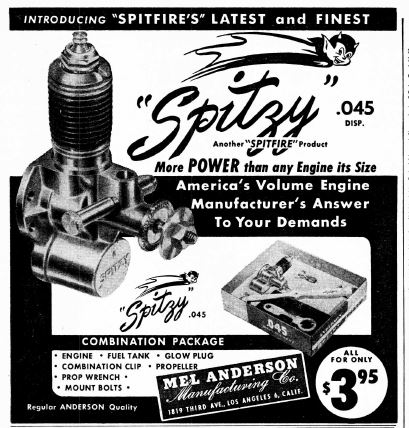
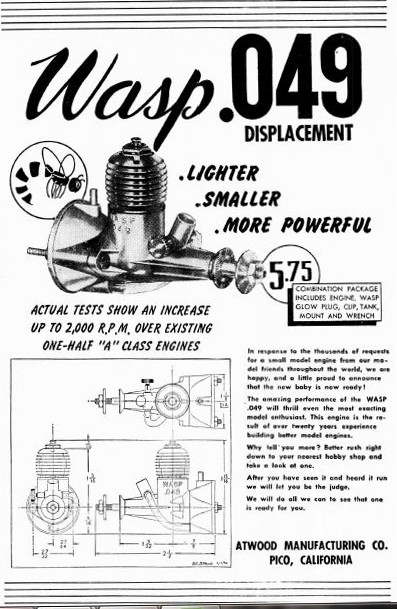
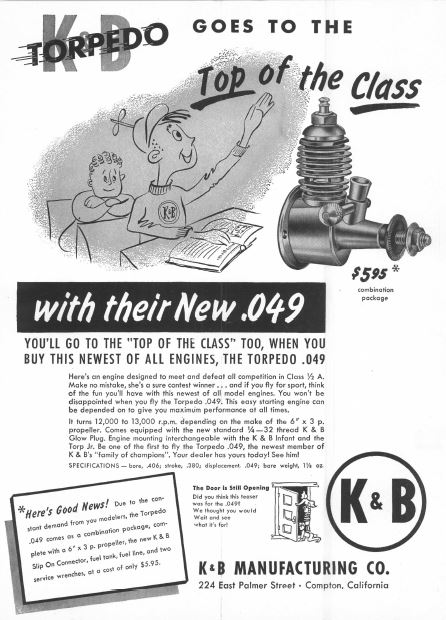
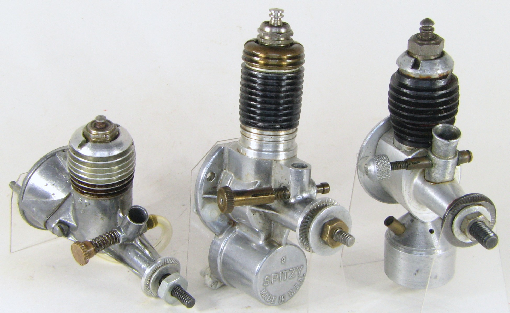
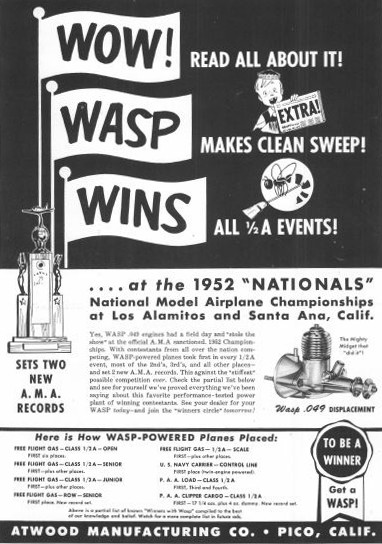
In September 1950, three new engines hit the market. Mel Anderson redesigned the Baby Spitfire with a sturdier needle-valve assembly and integral die-cast tank, putting the "Spitzy" .045 out at $3.95. Renowned designer Bill Atwood — who had started with Mel Anderson in the 1930s Baby Cyclone days, then designed the Phantoms, Bullets, Crowns, Phantom Torpedoes, Champions and Triumphs — announced his Wasp .049, sold as a combination package with its own glow plug and accessories. The Wasp's performance dominated all other .049s at the time. And K&B adapted their Infant design to the larger Torpedo .049, using a standard K&B ¼-32 glow plug; but the Wasp had relegated the other .049s to sport-engine status.
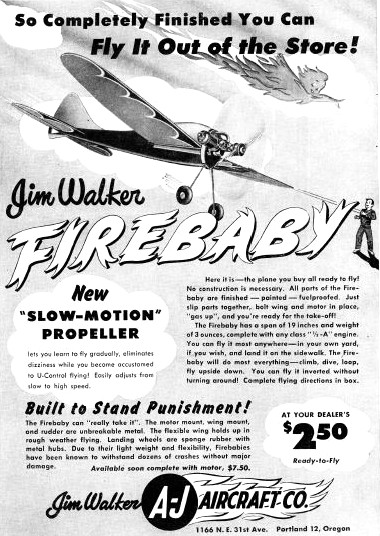
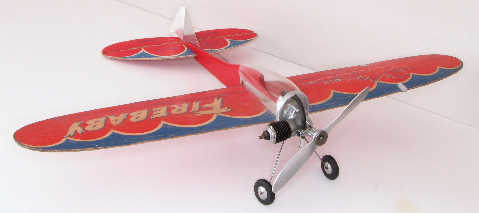
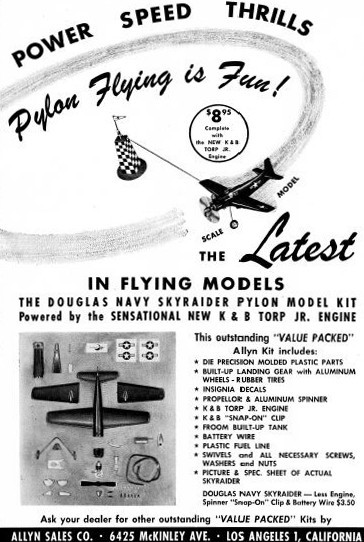
In October we were introduced to the iconic Jim Walker AJ Firebaby, beloved by hundreds of flyers as their first airplane. Soon advertised with the Baby Spitfire, it came with a "slow-motion" stamped-aluminum 5" prop of low pitch for learning — as you progressed, you twisted more pitch into the blades. Also highlighted was the Allyn Skyraider, a tiny all-plastic plane supplied with the K&B Torp Jr., which flew around a pole on a tether. A new control liner by the Mack brothers, the Aeromite — powered by the Baby Spitfire .045 — was Wen-Mac's first plane.
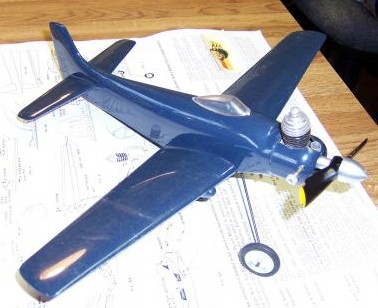
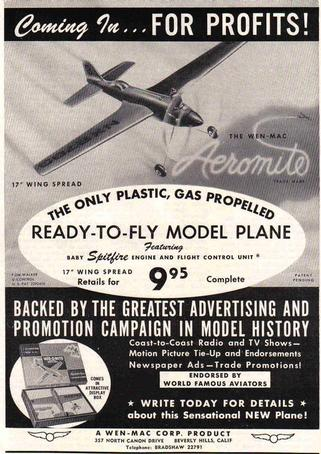
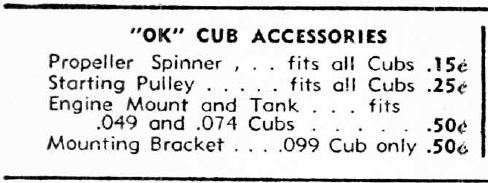
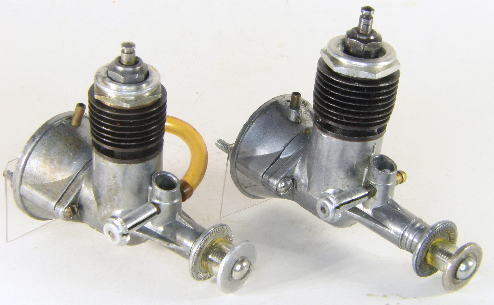
Bob Holland, who worked with Bill Atwood, told a story at MECA's EXPO III in 2002: Anderson test-ran every engine for the critical Wen-Mac contract, but the glow plugs were defective and most wouldn't light after the first run — causing Wen-Mac all kinds of problems, as the Aeromites had been widely distributed for Christmas. After that, Wen-Mac used Atwood's Wasp .049 until they made their own engine. To end 1950, OK advertised accessories separately that had previously only been sold in combination packages, and announced the OK CUB .039 — keeping the .049's .390" bore but shortening the stroke to .334", to compete with the Torp Jr. when an .049 wasn't required.
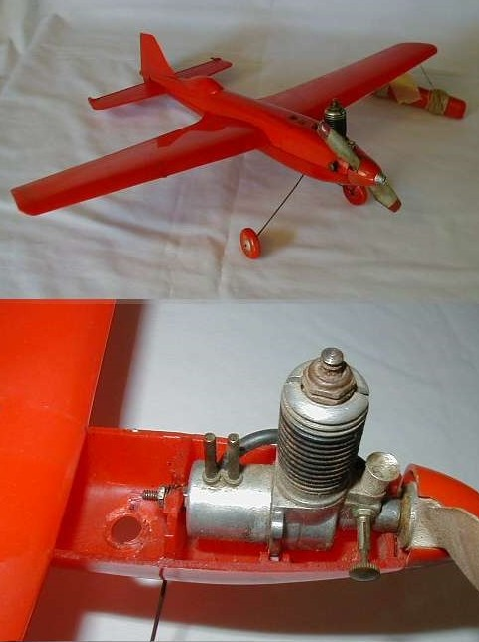
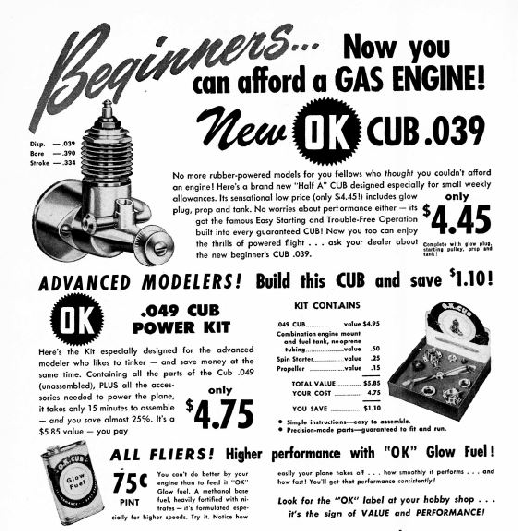
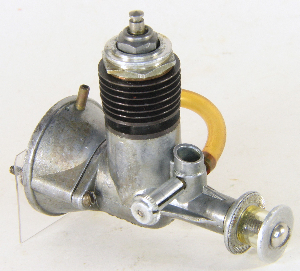
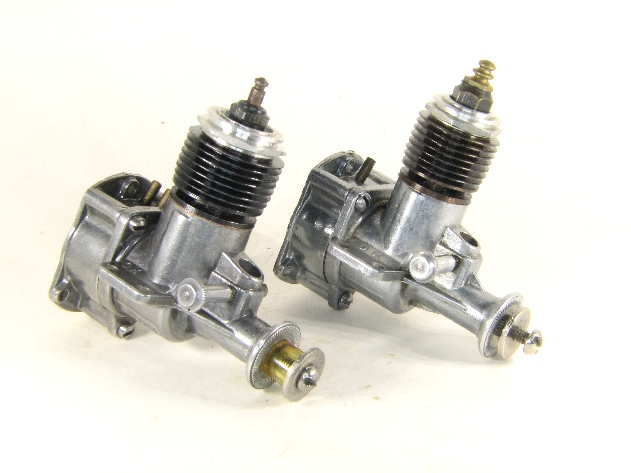
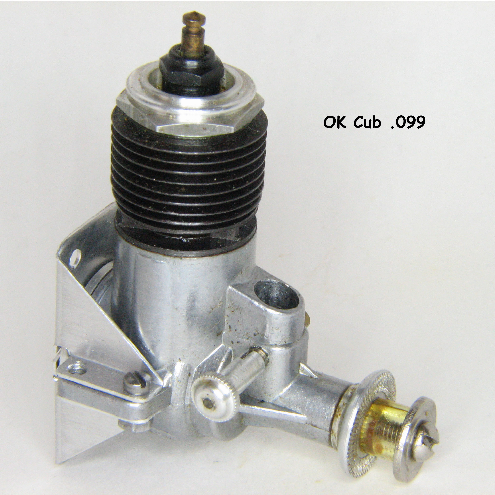
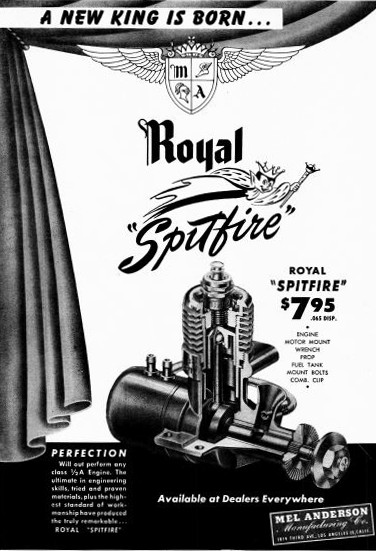
Joe Mutty reviewed the Cub .039 in the December 1950 MAN, getting 11,500 rpm on a 5¼-4 Kaysun plastic prop. Les McBrayer opened 1951 with a review of the Torpedo .049, reaching 14,000 rpm (16,800 on an Air-O single blade). Watching Brebeck's moves at Herkimer, Mel Anderson put his Royal Spitfire .065 on the market in March 1951, perhaps to compete with the OK CUB .074. Duro-Matic finally entered the 1/2-A scrap with their Baby Mac .049 — with its McCoy-trademark red head, jet-black cylinder and tumbled case, one of the prettiest engines of the era.
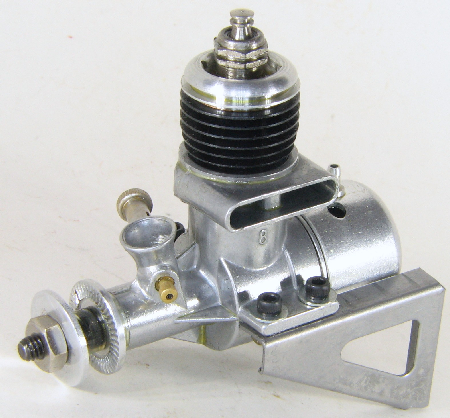
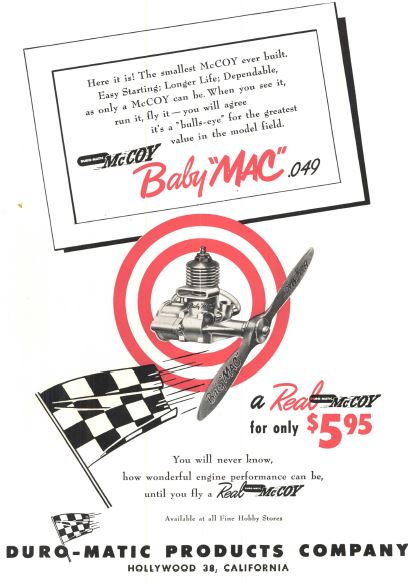
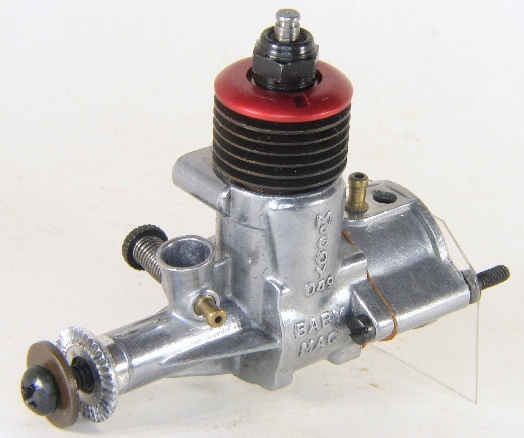
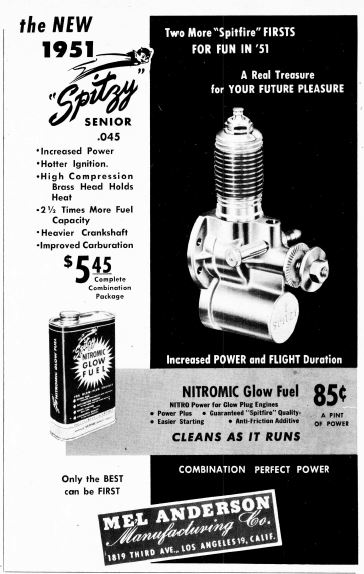
An improved Spitzy appeared in May — the Spitzy Sr. .045, with a stronger crankshaft and a longer, higher-capacity tank. 1/2-A engines were now firmly established; magazines and ads were full of new accessories, kits and designs, and 1/2-A events were being held as free-flighters especially enjoyed another competition class. The Atwood Wasp .049 had been the engine to beat since the fall of 1950 — but in the fall of 1952, other manufacturers were going to challenge.
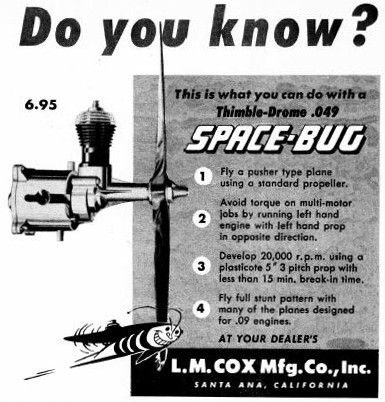
First out was L. M. Cox in August 1952 with the Thimble Drome Space Bug .049. This radical new design used rear reed-valve induction, large bypass ports, and a big "stunt" tank that ran inverted and for minutes longer than competitors'. It was very easy starting and could run in either direction. The first ad showed a ¼-32 glow plug, as the real heads weren't ready; ads two months later showed the now world-famous Cox glowhead. In September, Cox advertised their own ¼-32 plug — confident enough to charge almost 50% more than competitors.
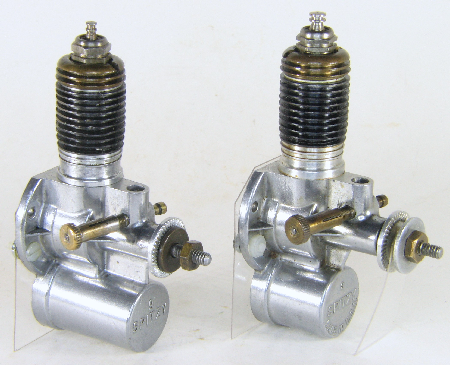
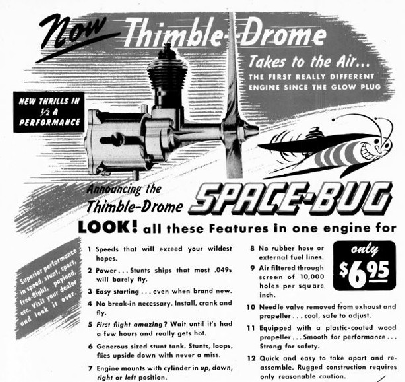
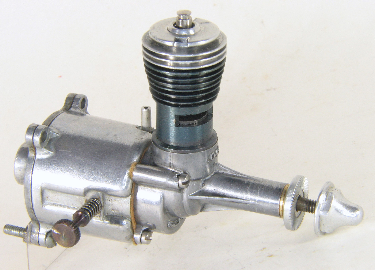
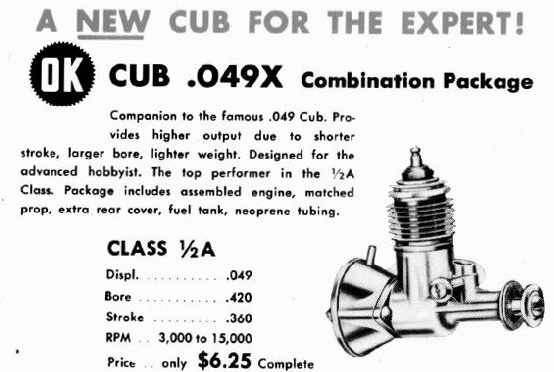
Mel Anderson was next with an improved-performance .049 — his beautiful little Royal Baby Spitfire, sold of course in a combination pack. (Competition was such that makers often bought full-page ads; many are reduced here.) In October, the Space Bug ad now showed the Cox glowhead. The OK Cub .049X was the last of the performance .049s of 1952 — a new design (though similar to the .039), it adopted the short-stroke style with a .420" × .360" bore and stroke, its integral-tank radial mount using the same bolt pattern as the Wasp, Royal Baby Spitfire, and the little Cub .039.
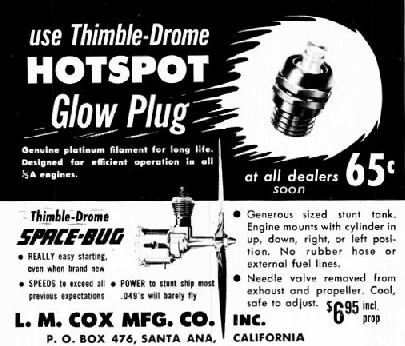
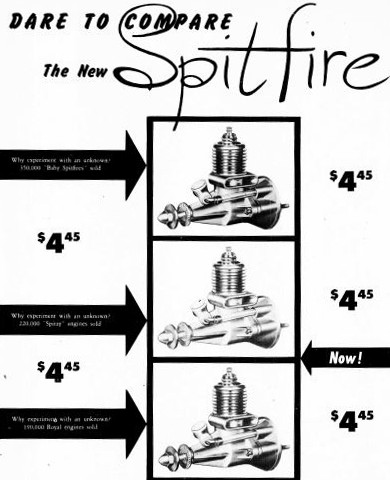
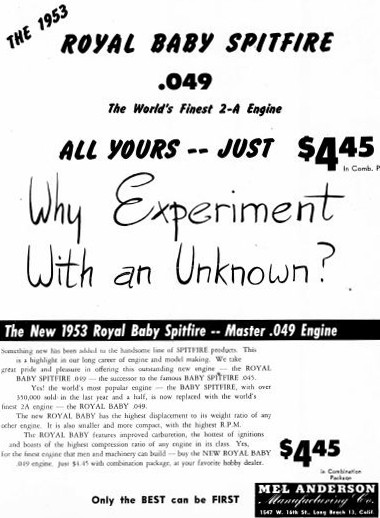
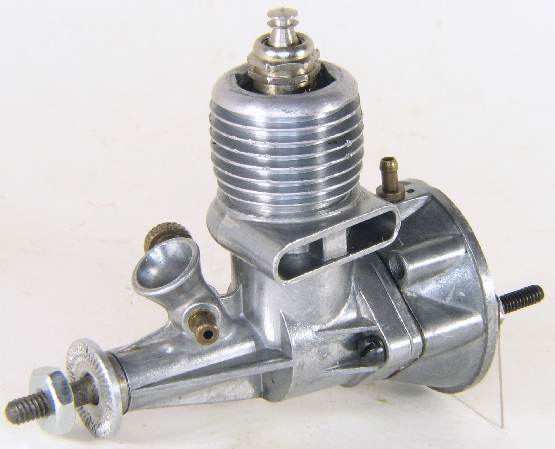
The 1/2-A era had begun at the end of 1948 with the K&B Infant .020. Two years later the .049 had become the unquestioned dominant 1/2-A displacement; makers like O&R, Allyn and Wen-Mac would get in later. The Space Bug was a very strong engine — 16,000 rpm on a 6-3 — but its real home was 1/2-A free flight, where its large stunt tank was of no value. The TD Thermal Hopper of 1953 would be stronger still, with no tank, and would eventually displace the Wasp; but for now, the Wasp ruled.
Sources: Nathan Gordon, "The Ancient Glow Plug," MAN Apr. 1948; Tim Dannels, "K&B Torpedos — Smaller Goes Big Time," Engine Collectors Journal 214, Feb. 2013; Ted Brebeck, They Should Have Kept the Bear (Caretaker Publishing, 1995).