Announced in 1963 as the result of twenty years of research and forty-five prototypes, the horizontal-piston Aero .35 was called "the most remarkable model engine to hit the market in a very long time." It became one of Tim Dannels' favorite engines.
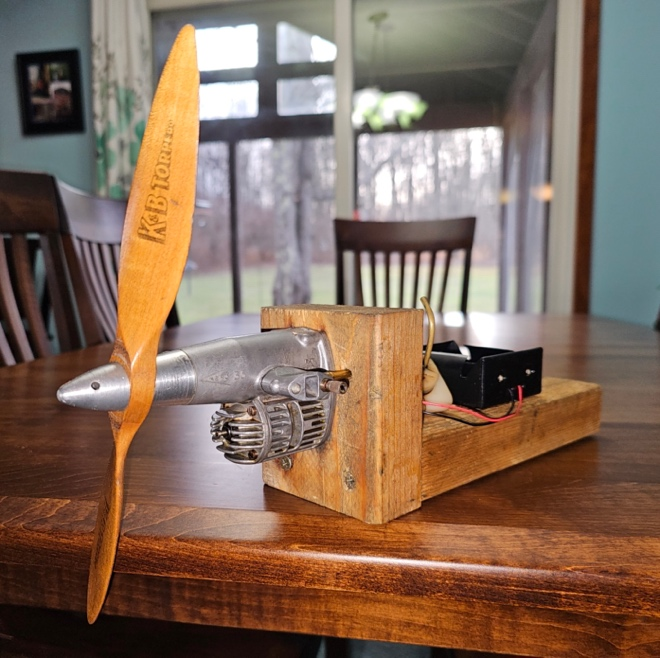
The Aero .35 horizontal-piston engine was announced in the June 1963 Model Airplane News (MAN) in a full-page advertisement by Aero Research & Development Co., Inc. It was claimed to be the result of twenty years of research and forty-five prototypes.
Bill Netzeband, in his Sept./Oct. 1963 American Modeler review, stated that the Aero .35's streamlined profile would benefit scale model builders and that its low vibration would be an advantage for radio control and stunt fliers. P.G.F. Chinn, reviewing it in the January 1964 MAN, called it "quite the most remarkable model engine to hit the market in a very long time," concluding that the design was technically sound and structurally well considered. R.H. Warring, in the December 1963 AeroModeller, said the engine works and runs extremely well.
Although the Aero .35 received favorable comments, it was expensive — $34.95 for the control-line / free-flight version and $40.90 for radio control. Its performance was about twenty per cent less than that of a conventional engine, according to Chinn's review, and its weight was substantially more than a typical .35, which had to be considered in the model's design to achieve the proper center of gravity. According to David Janson, only about one thousand Aero .35 engines were manufactured (see his book Model Engine Designer and Manufacturer Profiles). Stu Richmond, in his "Engines of the World" column in the July 1986 Model Builder, noted the Aero .35 was out of production within about three years (early 1966).
Due to its relatively low production and innovative design, the Aero .35 became a highly desirable engine among collectors, and it often commands a very high price when available for sale.
Tim Dannels' transparent display engine
The Aero .35 was one of the late Tim Dannels' favorite engines. Although the magazine reviews gave detailed explanations of the engine's unique internal mechanism (see also MECA Bulletin No. 342, May–June 2023), Tim felt a need for a better way of showing how the engine works. So he made a transparent Aero .35 display engine, machining a crankcase, cylinder, and cylinder head from clear plastic. Aero Research & Development Co., Inc. supplied Tim with all of the genuine Aero .35 internal parts, the rear cover with spherical bearing, and the propeller drive assembly free of charge.
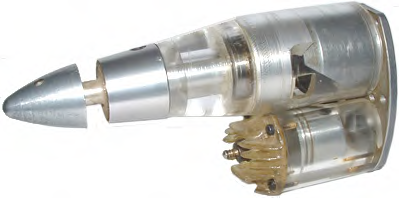
Tim often ran the Aero .35 at engine-collector gatherings and would have his transparent display engine on hand to show how the unique internal mechanism worked. He flew the Aero .35 in his seven-foot-wingspan Gas Champ free-flight model, and said it performed flawlessly and pulled the model up easily.
Tim Dannels' own Aero .35 and his transparent display engine have been generously donated by his family to MECA. A MECA Officer will serve as custodian of the engines, and they will be used as a symbol of our hobby at MECA displays — and as a remembrance of a man who contributed so much to the hobby of model engine collecting.
With thanks to MECA Historians Bill Bickel and Jeff Prescott for providing material for this article.